The Blog (or, “The Web Log” if you’re over 30)

Replacing Hydrow Seat Wheels

This is my true story of replacing worn-out wheels on the seat of my Hydrow rower. I am not taking responsibility for any injuries or damage incurred by anyone who uses this information to attempt the same.

What I needed:

  • 5mm allen wrench (see note below about length)
  • 10mm box-end or crescent wrench (monkey wrench will do)
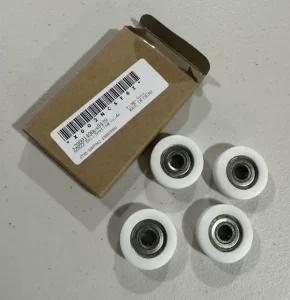
  • Replacement wheels (uxcell 608ZZ Ball Bearing Guide Pulley Roller Round Wheel 8x32x12mm)
  • Large Phillips and/or Slotted Screwdriver
  • Blue LocTite (if you really want to do it right)

Hydrow seat wheels developed cracks

A few weeks ago, I started becoming acutely aware of how rough my Hydrow seat rode along its track… like a train bogie hitting a join on a railroad track. I looked at the wheels carefully (at least, as carefully as I could with the seat still in place) and saw that three of them had split completely.

My machine has just over 1 million meters rowed and is a few years old. I contacted Hydrow support for help, and they asked me to provide all sorts of information about when I bought the rower and where I got it from. I did the best I could, but this is an old rower (I think I was an early adopter) and there was no chance that this was going to be a warranty claim.

The person at Hydrow customer support said I needed a new seat. Those are for sale from them for $150. Crazy. There was nothing wrong with the seat I had, except that the wheels needed replacement. And, since the wheels are a wear item, it seems like wheels should be something they’d sell me. Thankfully my car dealership doesn’t tell me I need a new wheel when I need my brake pads changed.

I took my story to the Hydrow Facebook group and asked if anyone knew the specs for these wheels. I got some friendly responses, and a user named Michael Maloney came through with an Amazon link to exactly the thing. $12, or to put it another way, a hundred and thirty-eight dollars less than Hydrow’s fix. I decided to go with that plan.

It took me about twenty minutes to do this swap, and I photographed each step so that if you want to try it (and again, I am absolutely not taking any responsibility for whatever injuries or property damage you might manage to cause), you at least know what’s involved.

Remove the back plate

Step one is to slide off the plate at the very end of the track by pressing the center and pushing it downward (toward the floor).

Unscrew the rear cap

Two pretty obvious screws present themselves when you get that plate off. You need to unscrew these and remove them so that you can slide the seat off the track.

Clean the Track!

You should be wiping any accumulated dirt out of the seat track periodically, but a really good time is when the seat is off. Remember to get the upper lip and inside of the track at the same time.

Which Wheels?

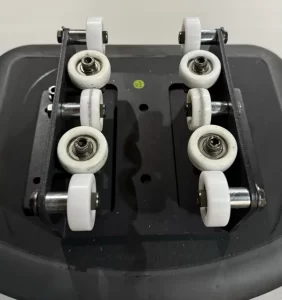
I didn’t really know how many wheels I was going to find when I took the seat off, but for anyone who guessed TEN, you are ahead of the game. Now, the wheel set that I bought from Amazon included only four wheels, but as I’ll explain below that’s really all I needed. I elected to replace the four on the ends (three of which, as you can see from this photo, were split).
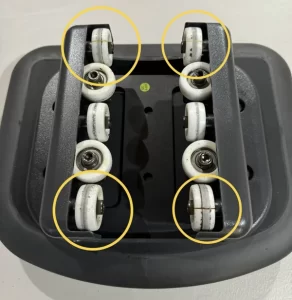
The side view (below) shows better how the wheels are oriented. Remember as you look at this that the seat is upside-down in these photos, so the wheels that seem highest are actually the lowest ones.

The two wheels on the ends (the front and back, as it were) are the wheels that roll on the bottom of the track and bear the weight of the rider (I was going to say rower, but since the machine itself is also called a rower, that seems confusing). So those four wheels (two to a side) are the ones that are going to wear fastest.

The wheels in the center (one to a side) keep the seat from binding on the top of the track if your rowing motion somehow causes the seat to lift. Since there’s some wear on those two wheels, I guess that it happens sometimes.

Finally, the two wheels on each side that are oriented horizontally are there to keep your seat centered as you move back and forth. These are also not weight-bearing, so should last longer than the wheels on the ends.

Remove the Cover (Housing)

It looks like you could just unfasten the wheels with your 5mm allen wrench and skip removing the cover, and you can try it, but for reasons that will be explained below I had to take the cover off. This involves removing four screws. (Sharp-eyed viewers will see that this photo was actually taken during re-assembly and not dissasembly, as the shiny new wheels are evident.)

Remove the Wheels

This part can be a little more challenging. For one thing, it’s easy to have an Allen wrench that is too long for the job. My handy all-in-one Allen wrench set wouldn’t let me get the opposition I needed to unfasten these bolts. I ended up using a longer wrench I had with one of those fancy rounded ends and it did the job just fine.

Another challenge I ran into was that although a couple of the bolts came off with no trouble, for the others the bolt that loosened was the one holding the axle to the seat frame and not the one holding the wheel to the axle. It was literally 50/50. If the wheel and axle come off together, you’re going to have a little more work to do.

Finally, all the bolts (wheel side and frame side) have a bit of LocTite on them, so some force is needed to get them started.
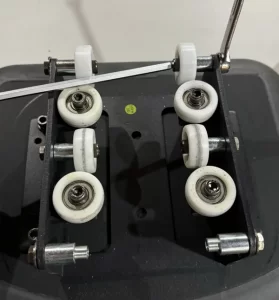
It almost never happens that a project can go off with out any problems at all, and for this project the hiccup were the wheels that unscrewed at the frame end of the axle instead of the wheel end.
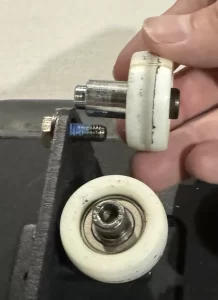
To the Vice!

To get the wheels off the stubborn axles, I used my bench vice. Something like vice grips would probably work, too. It shouldn’t matter if the axles get a little scuffed because they don’t need to be smooth (except at the ends where they are inserted into the seat frame and the wheel).

If you do get into a situation where the axle detaches from the seat frame, keep track of which end of the axle is which — it is asymmetric. If you try to insert it into the seat frame backward, you’ll never be able to tighten it… should be pretty obvious.

New Wheels!

The link is above. The replacement wheels come four to a set, so you will need multiple sets if you plan to replace more than just four wheels.
Attach New Wheels and Reinstall

The new wheels go on exactly as you’d expect. If you want that factory feel, use a bit of LocTite on the threads the way Hydrow does.

Re-assembly is pretty much the opposite steps you used get this far, but I’ll list them here:

  • Install new wheels
  • Attach housing (wheel cover) with four screws
  • If you didn’t wipe off the track before, do it now.
  • Slide the seat back onto the rail. Make sure you have it pointing in the right direction — it is possible to put the seat on backward, and you’ll know you did when you sit down and try to row.
  • Attach the end cap to the rail using the two screws you removed before.
  • Slide the end plate on.

Happy Rowing!

Thanks again to Michael for sending me the link to the wheels I needed on Amazon.

Pennsylvania closer to statewide ban on declawing

Last week, state senator Carolyn Comitta issued a memorandum announcing that she was going to introduce a bill to ban declawing in Pennsylvania, as a companion bill to HB508 in the state house. Declawing is already illegal in some communities, including Allentown and Pittsburgh.

Once considered standard practice for housepets, declawing has become steadily less popular over the past several decades, in part due to increased awareness of what declawing actually entails (hint: it is not just a kind of enhanced nail trimming).

Read Pennsylvania House Bill 508.

The practice of cat declawing has a history dating back several decades. It became more common in the mid-20th century as a means to prevent cats from damaging furniture and to address scratching-related issues in households. The procedure gained popularity, especially in North America, during the 1950s and 1960s.

Initially, the procedure was promoted as a solution to protect furniture and prevent scratching-related injuries to humans. However, over the years, concerns about the ethics and potential negative consequences of declawing have led to increased scrutiny and changing perspectives.

The procedure has faced criticism from animal welfare organizations, veterinarians, and advocates who argue that it is a painful and unnecessary surgery that can lead to behavioral and physical problems in cats. As a result, some jurisdictions and professional veterinary associations have taken steps to discourage or restrict the practice, emphasizing the importance of alternatives such as regular nail trimming, providing scratching posts, and using soft nail caps.

In Pennsylvania, communities such as Allentown, Easton, Etna, and Pittsburgh have passed local laws to prohibit declaw procedures.

Chat GPT: Sometimes wrong, but never in doubt

I don’t use AI to create my blog posts. For one thing, the world scarcely needs more blog posts in the the first place, and if you’re going to throw one on the pile at the very least one should ensure that it’s not made up of 100% recycled thoughts.

That said, I do use AI in other aspects of my work. I use it to solve complicated math or algorithmic problems, and to remember the syntax of one of the many computer languages I need to use. It’s absolutely brilliant at that.

When it gives me correct answers, that is.

Which leads me to my biggest problem (and concern) with AI. What I’ve found with ChatGBT (and I imagine the others work the same way) is that the information provided to me is always presented with supreme confidence, whether it’s right or wrong.

We all know somebody like this. Everything he or she says comes out with complete certainty. Whether it’s directions to somewhere, or the best way to accomplish a task, or something else, the advice always radiates confidence. It’s what gives life to the expression “often wrong, never in doubt.” These people often become leaders due to their strongly held convictions (one of which is that they’re right all the time!)

Sadly, ChatGPT is one of these people. Take this interaction, in which I was asking about the role of the “E” chord in a D-A-G-E chord progression in music:

ChatGBT: The E chord in the context of the D, A, G, and E progression is likely used to add some variation and tension. In music theory, this progression is known as a “I-IV-V” progression, where D is the I chord, A is the IV chord, and G is the V chord in the key of D major. Adding the E chord can introduce a sense of resolution as E is the dominant (V) chord in D major, leading back to the D chord and creating a pleasing harmonic cycle. It’s a common progression in many songs.

Me: E is not the V chord of D major

ChatGBT: You are absolutely correct, and I apologize for the mistake. E is not the V chord of D major; it’s the IV chord. The V chord in D major would be A. Thank you for pointing out the error.

Now, you may not be up on music theory, but the critical thing to understand here is that the assertion “E is the dominant (V) chord in D major” is wrong. Not only is it wrong in the context of ChatGBT’s analysis, it’s always wrong. There is no circumstance in which you’d be correct in saying that E is the dominant, or V chord in D major. (Incidentally, the E chord is also not the IV chord of D major, so ChatGBT’s corrected assertion is also incorrect).

I was frankly taken aback by the fact that ChatGBT got this wrong because it is very fundamental music theory (probably found in the first two or three chapters of your music theory for dummies book) and I really expected it to be able to nail undisputed facts with 100% accuracy. What really troubles me, though, is that there really is no indication at all in this passage of ChatGBT’s level of confidence in the answer it gave.

Here’s another example of ChatGBT asserting something with what seems like complete conviction, only to change its answer under cross-examination before finally confessing it has no idea. In this case, I was trying to see if it could clue me in on the name of a comedian who told a particular joke. Again, note the complete certitude of its answers.

Me: I remember a comedian joking about Gordon Sumner’s nickname, “Sting”. There was a line something about, “I would like you to call me Sting”. What was the comedian?

ChatGBT: The comedian you’re referring to is probably Eddie Izzard. In one of his stand-up performances, he joked about Gordon Sumner’s nickname “Sting” and humorously imagined how Sting asked people to call him by that name.

Me: Can you tell me the quote?

ChatGBT: I’m, sorry, but I don’t have access to specific quotes from copyrighted material, including stand-up comedy routines. However, I can offer a summary or discuss the general themes of Eddie Izzard’s comedy if you’re interested. Just let me know how I can assist you further!

Me: Are you sure it’s Eddy Izzard?

ChatGBT: I apologize for any confusion. It appears I made an error in my previous response. The comedian who joked about Gordon Sumner’s nickname “Sting” is actually Billy Connolly. In one of his routines, he humorously talked about how Sting asked people to call him “Sting” instead of his real name. I apologize for the mistake and thank you for bringing it to my attention.

Me: I can’t find any reference to Billy Connolly making that joke

ChatGBT: I apologize for the confusion earlier. You are correct, and I appreciate your understanding. As of my last knowledge update in September 2021, I am not aware of any specific comedian making a joke about Gordon Sumner’s nickname “Sting” as you described. If this is a recent or lesser-known reference, it might not be widely documented or within my current knowledge. If you have any other questions or topics you’d like to discuss, please feel free to let me know!

Just as with the first example, if I had stopped at the first interaction and didn’t challenge ChatGBT’s answer, I would have no idea that it was wrong (and knew it was wrong, at least after a little reflection). Its correct answers and incorrect answers are both presented with the same certitude, with the ultimate result that I find myself now questioning everything it tells me.

I have seen ChatGBT and other AI services do some amazing things. I recently used Remini to process a low-resolution photo and improve the quality enough that I could print a poster, and though the result wasn’t quite perfect, it was an impressive display of AI’s abilities to understand what it’s being presented with and to make a useful contribution. I am really interested in seeing where all of this is going.

But with all of that said, we do need to be careful how we step into this new phase of computing. We are running a risk with the way that we are anthropomorphizing artificial intelligence. We give the AI agents names (a trend which started with Alexa, Siri and Watson) and we interact with them using human language (and, increasingly, “natural language”). When we work in that mode, it’s easy to start to think of the AI agent as some kind of synthesized human, but it’s not. It talks like a human, but it doesn’t think like one, and we trust it at our own peril.

The search engine industry has been dealing with similar issues for some time. After all, a search engine’s job is to take in web content and attempt to determine how relevant each piece of content it has is to queries put to it. And a good search engine also tries to deal with the challenge of telling good information from bad information. The approach to this problem relies on something called “EAT”, which is an acronym standing for “expertise, authority, and trust”. Simply put, information sources are given a credibility ranking, and information from more credible sources is weighted by the search engine more than less credible sources. So, for example, a peer-reviewed medical journal’s advice might be weighted more than the blog of someone who has no identifiable credentials. Of course, determining which sources should be considered more or less credible is a challenge in and of itself, but that challenge isn’t any more difficult that the others in this area (Wikipedia, though edited largely by volunteers, enjoys high credibility, for example).

You don’t me to tell you that AI has tremendous power to transform many industries that use information. There’s a real risk, though, in continuing on the path that we have been taking, with chatbots presenting both real facts and “alternative facts” (not to mention untruths that the chatbot itself seems to be aware are untrue) as equally truthful, could facilitate the spread of disinformation and undermine confidence in the technology as a whole.

Alexandra Horowitz on “When We Talk About Animals”

Alexandra Horowitz is one of my favorite authors, and I was disappointed when her Freakonomics podcast “Off Leash” did not survive beyond the first couple of episodes. However, you can catch her on a recent episode (#49) of the When We Talk About Animals podcast. This podcast describes itself as “A Yale University podcast devoted to exploring the big questions animals raise about what it means to be human.”

This episode is mostly about her book “The Year of the Puppy”, but rather than write about it I’ll just include the link and you can listen for yourself.

ABOUT ALEXANDRA HOROWITZ

Alexandra Horowitz is a notable American cognitive scientist, author, and professor, recognized for her contributions to the field of animal cognition and her engaging exploration of human perception and behavior. Born in 1974, she earned her undergraduate degree in philosophy from the University of Pennsylvania before pursuing her Ph.D. in cognitive science at the University of California, San Diego. Horowitz’s academic journey reflects her interdisciplinary approach, incorporating elements of psychology, philosophy, and biology into her research.

Her breakthrough work includes studies on animal behavior, particularly in the realm of dog cognition. In her bestselling book “Inside of a Dog: What Dogs See, Smell, and Know,” Horowitz delves into the intricacies of a dog’s sensory world, offering readers a captivating journey into the minds of our canine companions. Her ability to translate complex scientific concepts into accessible and engaging narratives has made her a respected figure in popular science writing. Beyond her literary achievements, Horowitz is a professor at Barnard College, Columbia University, where she continues to explore the fascinating intersection of human and animal cognition.

Alexandra Horowitz’s dedication to bridging the gap between scientific research and public understanding has earned her widespread acclaim. As a thought leader in the field of animal cognition, she not only contributes to our understanding of the minds of animals but also encourages a deeper appreciation for the diverse ways in which different species perceive and interact with the world. Through her books, research, and teaching, Horowitz has left an indelible mark on the study of cognition, enriching our understanding of the complex relationships between humans and the animal kingdom.

On Reaching Zwift Level 50

Today I accomplished what used to be the ultimate goal of Zwift — reaching level 50. True, the original top level of Zwift was 25, but for most of the game’s history, level 50 was the ultimate target. 500,000 experience points and you are top dog. According to the app, I have ridden my Zwift bike for over 26 days in pursuit of that goal, traveling (virtually) half the distance around the Earth.

Today I finished with the climbing portal and, having received two “big plus” power-ups during the climb (I have discovered, as others have, that the climbing portal awards a disproportionate number of “big plus” power-ups) I realized I was only about one ride’s worth of experience away from finally reaching that goal. So, back to the climbing portal I went.

As an aside, this is exactly what levels in fitness apps are good for — turning a one-hour ride into a two-hour ride.

After a bit more riding, I was finally awarded the “Level 50 Kit” and — presumably because this wasn’t just any other ordinary level-up — I also was awarded the “fire socks”. What are fire socks you say? Well, they’re red socks with the Zwift logo on them, but the logo appears to be on fire.

Make no mistake, though, the fire socks are the real prize. Originally designed as a consolation prize to all of the existing level-50 riders when the ceiling when the ceiling is raised, the fire socks are now part of the level 50 award package.

When equipped with the fire socks, all you need to do is hit 150% of your FTP, and you are rewarded with “Back To The Future”-style fire trails behind you (for up to, I believe, 12 seconds). Now, that’s the kind of UI upgrade I can use!

Fire socks

Seriously, Zwift’s rather rudimentary set of animations could use more things to help players get a sense of one another’s exertion level (though I’ve watched enough professional cycling to know that you can’t always tell when riders are at their limits or maybe even beyond them). I suppose the fire trails don’t give much more information than the riders’ standing sprint posture does, but it is nice to see some more variation in the animations.


Zwift vs Rouvy vs MyWhoosh

ABOUT ZWIFT:

Zwift is a leading virtual cycling and running platform that has revolutionized indoor fitness by combining interactive technology with immersive gameplay. Designed for cyclists and runners of all levels, Zwift transforms stationary training into a social and engaging experience. Users can connect their smart trainers or treadmills to the platform, allowing Zwift to adjust resistance or incline based on the virtual terrain they’re traversing. This dynamic interaction provides a realistic and challenging workout, mimicking the feel of outdoor cycling or running.

At the heart of Zwift is its vast virtual world, featuring stunning landscapes inspired by real locations. Users can explore these visually rich environments, ranging from city streets to picturesque countryside, while interacting with other participants from around the globe. Zwift’s social aspect is a key component, enabling users to join group rides, participate in races, or embark on solo adventures. The platform also supports structured training plans and workouts tailored to individual fitness goals, making it a versatile tool for both casual enthusiasts and competitive athletes seeking effective indoor training.

Zwift has cultivated a vibrant and supportive community, fostering a sense of camaraderie among users. Whether engaging in friendly competitions, collaborative group rides, or pursuing personal fitness objectives, Zwift brings together individuals with a shared passion for cycling and running. Its seamless integration with various devices, compatibility with popular smart trainers, and regular updates to enhance the virtual experience contribute to Zwift’s status as a leading platform in the realm of interactive indoor fitness.

ABOUT ROUVY:

Rouvy stands out as a dynamic and immersive indoor cycling platform designed to elevate the indoor training experience for cyclists of all levels. What sets Rouvy apart is its emphasis on augmented reality routes, offering users the opportunity to ride through real-world locations via a library of video routes and virtual routes. This unique feature allows cyclists to experience the thrill of cycling on iconic roads, enhancing the realism of their indoor training sessions. Whether navigating challenging ascents or cruising through scenic landscapes, Rouvy strives to bring the outdoor cycling experience indoors.

The platform’s focus on realism extends beyond just visuals. Rouvy enables users to compete against fellow cyclists in real-time multiplayer races, fostering a sense of competition and camaraderie. With compatibility for various smart trainers and devices, cyclists can seamlessly integrate their equipment with the platform, allowing for responsive adjustments to resistance and terrain changes. Rouvy also provides structured training plans and workouts, catering to users seeking targeted and effective training sessions.

Rouvy’s community aspect thrives on the shared love for cycling. Users can participate in multiplayer races, challenges, and events, creating a social and engaging environment for indoor training. The platform’s commitment to delivering a realistic and challenging experience, combined with its diverse library of routes and community-driven features, positions Rouvy as a compelling choice for cyclists looking to stay motivated and connected while training indoors. For those seeking a virtual cycling experience that goes beyond basic simulations, Rouvy offers an exciting and authentic alternative.


1. **Zwift:**
– **Type:** Virtual Cycling and Running Platform.
– **Key Features:**
– Offers an immersive virtual environment for cycling and running.
– Provides interactive workouts, group rides, races, and social features.
– Compatible with various smart trainers and sensors.
– Integrates with third-party apps and devices.
– **Community Aspect:**
– Boasts a large and active user community worldwide.
– Allows users to ride with friends, join group rides, or participate in organized events.
– **Training Plans:**
– Offers structured training plans and workouts for different fitness levels.

2. **Rouvy:**
– **Type:** Indoor Cycling Platform.
– **Key Features:**
– Focuses on realistic augmented reality routes for cycling.
– Provides a library of real-world video routes and virtual routes.
– Enables users to compete against other riders in real-time.
– Compatible with various smart trainers and devices.
– Offers training plans and workouts.
– **Community Aspect:**
– Rouvy has a community of cyclists sharing and riding real video routes.
– Users can participate in multiplayer races and challenges.

3. **MyWhoosh:**
– **Type:** Fitness Tracking and Virtual Challenges.
– **Key Features:**
– A fitness app that allows users to set and track fitness goals.
– Offers virtual challenges, allowing users to compete against others.
– Users can sync their activities from various fitness trackers.
– Provides a social platform for connecting with friends and other users.
– **Community Aspect:**
– MyWhoosh fosters a sense of competition and community through virtual challenges.
– Users can engage in friendly competition and share achievements.

**Comparison Points:**
– **Focus:**
– Zwift and Rouvy focus on virtual cycling and running experiences.
– MyWhoosh focuses on fitness tracking and virtual challenges.
– “Systm” (if a specific platform) would need more details for a comparison.

– **Features:**
– All platforms offer features like virtual challenges, social aspects, and compatibility with fitness trackers.

– **Community:**
– Zwift and Rouvy have active user communities, emphasizing group rides and events.
– MyWhoosh fosters a sense of competition and community through challenges.
– “Systm” needs clarification to provide specific details on its community aspects.

Since I don’t have specific details about “Systm,” consider checking its official website or documentation for the most accurate and up-to-date information. Additionally, features and offerings may evolve, so it’s always a good idea to check the latest details directly from the platforms.

Pro-business EATS act threatens animal protections

The “Ending Agricultural Trade Suppression Act”, HR 4417, was introduced in June 2023 by Ashley Hinson of IOWA, seeks to roll back a number of state protections for animals, such as California’s Proposition 12. As you may guess from its libertarian-sounding name, this proposed law would curb individual states’ ability to set certain standards for animal welfare.

The bill aims to promote agricultural trade by prohibiting state and local governments from imposing standards or conditions on the pre-harvest production of agricultural products if the production occurs in another state and the standard or condition is in addition to the standards and conditions set by federal law and the laws of the state and local government where the production occurs. It also establishes a federal cause of action to challenge state regulation of interstate commerce related to agricultural products.

Among other groups, the The ASPCA opposes EATS and encourages like-minded people to voice their opposition.

Dog Law to be amended, raising fees and funding

Senate Bill 746, aimed at strengthening Pennsylvania’s Bureau of Dog Law Enforcement (BDLE) has passed. The legislation, introduced by Sen. Elder Vogel, facilitates the online sale of dog licenses in all counties, increases penalties for violations of Pennsylvania’s Dog Law, and raises dog license and kennel inspection fees. The bill aims to stabilize the BDLE, which has been facing financial challenges and staffing shortages. It also introduces tiered license fees, with discounts for senior citizens, and imposes fines for unlicensed dogs. The bill now awaits the governor’s signature.

UPDATE: OCTOBER 24, 2023 – 
SB746 bill is signed into law.

Replacement Peloton Seat Post – What’s the difference?

Today I received my replacement Peloton seat post and had a chance to see first-hand what the changes are.

To recap, back in May of this year (102 days ago, to be exact) I, like many owners of the original model Peloton bike, received an email titled “Important Recall Notice”. This email read, in part:

Today, Peloton is announcing a voluntary recall of original Peloton model Bikes sold from January 2018 to May 2023 in the US. This voluntary recall is being conducted in cooperation with the US Consumer Product Safety Commission (CPSC). 

REASON FOR THE RECALL: The original Peloton Bike seat post can break unexpectedly during use, creating a potential fall and injury risk. Peloton has identified 35 reports of seat posts breaking out of 2,160,000 units sold in the US. There have been 13 reports of injuries, including a wrist fracture, lacerations and bruises.

Because my Peloton bike gets used nearly every day, I ordered my free replacement right away. A few weeks later I got an email saying that due to high demand, they were prioritizing riders above a certain height or weight. I didn’t meet either criteria, so I was in the last group to get a replacement post.

Evidently, Peloton fielded 750,000 requests for replacement seat posts, so it has taken them a bit of time to meet that demand. Anyway the post arrived via FedEx today, and only took a couple of minutes to install (Phillips-head screwdriver required). I examined the new post against the old, and they appear to be made of the exact same materials (powder-coated steel of the same gauge, as far as I can tell. The heft is similar). The only difference I could tell is that the welds between the segments (there are two welds) were significantly beefier on the new post.

Here are photos of the two posts, with the old post in the foreground. The difference in the thickness of the welding bead is pretty noticeable.

Peloton seat post front Peloton seat post top

Examining the old post, there are several spots where the powder-coating has worn off, but certainly no cracks, corrosion, or anything else that looked worrisome. Near as I can tell, it looks completely solid (though perhaps the ones that have broken looked that way, too!)

My Peloton bike has gotten years of daily or near-daily use, and it’s held up well. The only part I have needed to replace (apart from the pedals) are the plastic water-bottle holders (which are unfortunately made of very brittle plastic), and even these were a no-cost fix (I can’t remember exactly when I did that or how old the bike was at the time.) The bike is still quite and there has been no need to replace bearings or belts or anything. Sure, my wife and I are not particularly big or powerful riders, but this bike has had a lot of virtual miles on it, and it’s still going strong.

Zwift Point System Flaws

I am slowly closing in on Zwift level 50 which was (until recently) the highest level attainable. Alas, I suppose enough people had hit level 50 that Zwift HQ decided it needed to raise the roof to level 60, but I suppose it’s just as well. After all, my zeal for Peloton started to wane after ride #1000, and for Hydrow once I got my t-shirt for rowing a million meters, well, it was just hard to get psyched to do another million meters to get the hat. So if past is any indication, if they hadn’t raised the maximum level I probably would have started looking around for another platform.

Not that there’s a whole lot to be gained by maxing out Zwift. All you really get is some kit you’re probably not going to wear. There was sort of a cool Mondrian kit that I got a little while ago (level 40?) and wore for a while but mostly it’s not stuff you really want anyway. There are also some frames and wheels that are unlocked at later levels but once you have the Tron bike, the marginal gain from some of these super-high-end upgrades is pretty marginal. I guess you still need a time trial bike and a mountain bike, but there’s not a ton to differentiate any of them, really. 

(NB: And that’s a good thing. Zwift and similar platforms should really be about the rider and the effort and not things that you can buy. So if anyone is actually reading this, please don’t take anything I’m saying as an argument to have more differentiation between frames and wheels. Let the rider make the difference, I’m good with that.)

Still, there are levels, and where there a levels there are people like me who have an irrational need to get to the top. So I’d like to talk about how that’s done, and talk about a couple of very big flaws in Zwift’s system of awarding points.

Fundamentally, you get points for riding. The farther you ride, the more points you get. Zwift Insider has a good guide to the basics of the Zwift points system, so instead of rehashing those basics here, I’ll just point you to their site.

Did you actually go and read that page? The part about how riders using the metric system get points faster? I quote:

Sorry, Imperials: you will accumulate XP 7.3% faster if you ride in metric units. (100km=2,000 XP, while the equivalent mileage, 62.13=1864 XP.)

So, that by itself is a pretty big inequity right there. Why not give riders using the imperial system 32 xp instead? That’s still a fraction less than the metric system users get, but it’s a lot smaller difference than what they have today. That 7% or so difference between metric and imperial is absolutely huge when you start to think about the distances that you’ll be riding to level up.

The other big flaw in the awarding of Zwift points has to do with the fact that, outside of workout mode, Zwift points are awarded based on distance and not on effort. This means that to level up, one is behooved to do a lot of riding on flat roads in large groups where you can get the maximum speed for your effort. So, we’re talking a lot of Fuego Flats with the robot-pacers, which is about as boring as this game can get.

As I write this, the Tour of Watopia ’23 is drawing to a close. For the past month, I’ve been doing ToW rides because those rides give double points. So, for a month now, I’ve been seeking out the longest, flattest routes that are offered, because that is how I can gain the most points. Stages 3 and 4 (mountains and dirt, respectively) are the least valuable. Now that we’re into the “makeup week” it’s all Stage 1 (the flats) for me. Yawn.

As the saying goes, “What gets rewarded gets repeated.” So that’s why you’ll find me on the flats.

PS: Interested in “XP Farming”? There’s a good Reddit post here that uses the Crit City route and a time trial bike (capitalizing on the short length of the route and the fact that on the time trial bike you always get the XP bonus rather than another “power-up”). A much more elaborate (but more rewarding) strategy is offered by Shane Miller, involving interval workouts on the Alpe d’Zwift. You do need to complete the climb for it to work, and the big payout happens if you both own the lightweight wheels and then are awarded them at the top (so you are instead awarded 1000xp bonus). Shane says this happens often but frankly it has never happened to me. I’m always getting the helmet or some other prize that really should be accompanied by the “sad trombone” sound effect.