The Blog (or, “The Web Log” if you’re over 30)

Space: 1999 Reboot – Drop Tony Verdeschi

Any future reboot of Space:1999 is going to have to give serious thought to paring down the number of featured characters on the show, particularly if the modern 8-10 episode structure of television series prevails. There just isn’t enough time to develop more than a few story lines.

One character that I believe the series could afford to lose would be security chief Tony Verdeschi (played by Tony Anholt in the original series).

I do not offer this recommendation lightly: Tony was a favorite of mine as a kid. He was certainly more relatable to a teenager or pre-teen than Koenig (who, by design, had to function as the father figure in the show) and he was more a man of action than just about any of the other characters on the show.

In fact, there’s only one character that could rival Tony for the “man of action” title, and that would of course be Alan Carter, and it’s this overlap between Tony and Alan that makes one of them expendable.

When Tony’s character was introduced, he was a replacement for Paul Morrow, second-in-command on the base and Commander Koenig’s understudy. In practice, Tony’s character was far more like that of Alan Carter, the hot shot “shoot-first-ask-questions-later” lovable rogue of a character. Carter’s direct replacement, Bill Frazer, seemed destined to be more of a minor character, just the Eagle driver and maybe not much else.  

What happened in practice was that Alan Carter did not exit the show in season 2. According to lore, new producer Fred Freiberg was ready to jettison Carter along with most other supporting characters until his children insisted on him keeping the character.

According to Robert Wood’s excellent “Destination: Moonbase Alpha”, Actor Nick Tate (who played Carter) said Freiberg told him “My kids love you. My kids love the show and I went to them and asked who I should have back. They said I’ve got to have Nick Tate.“ (The Gerry Anderson version of the story was that ITC realized that Carter received more fan mail than any other cast member). Whatever the reason, Alan Carter returned to the show, and left Tony (and Bill Frazer) with a whole lot less to do.

The Paul Morrow character did exit the show, so there was some space in the ensemble for Tony to fill that role, but again, with Carter staying, the show simply didn’t need two character’s with the same perspective and approach.

Regarding any other unique qualities of Tony’s character, the biggest one certain was that he was the love interest of Maya, the alien. I’ll talk more about this when I get to that character, but suffice to say here that if Maya were to stay, it would not be difficult to romantically link her to Alan (or some other character). The same could be said for Tony’s beer-making running gag, which I’ll address in a future post.

In short, Tony’s character really didn’t add anything that wasn’t already there with Carter, and he just isn’t a character that needs much screen time.

Now that have recommended dropping Tony’s character from a potential reboot, I have to address that all-important question:

Who will make the beer?

Fans of the original show may cringe at the thought of more scenes of Tony’s beer making, and I will agree that a lot of it was awkward and often in contrast to the tone of the other stories in their respective episodes. Nevertheless, I think that Tony’s beer making was quite important because it highlights one of the things that was never given enough attention in the show: how the Alphans coped with being cut off from Earth. According to Dr. Russell’s medical log, some episodes of the original show were set years after “breakaway”, and even as a kid I wondered how not only did they never seem to run other of paper for the computer, but they also seemed generally nonchalant about things like paper an other consumables. Except when it was made a specific plot point, resource shortages seemed to be nonexistent. Tony’s beer was one of the only things in the show that acknowledged that Alpha was self-contained and that we’d hope that the Alphans would not only survive there, but find a way to adapt to the environment.
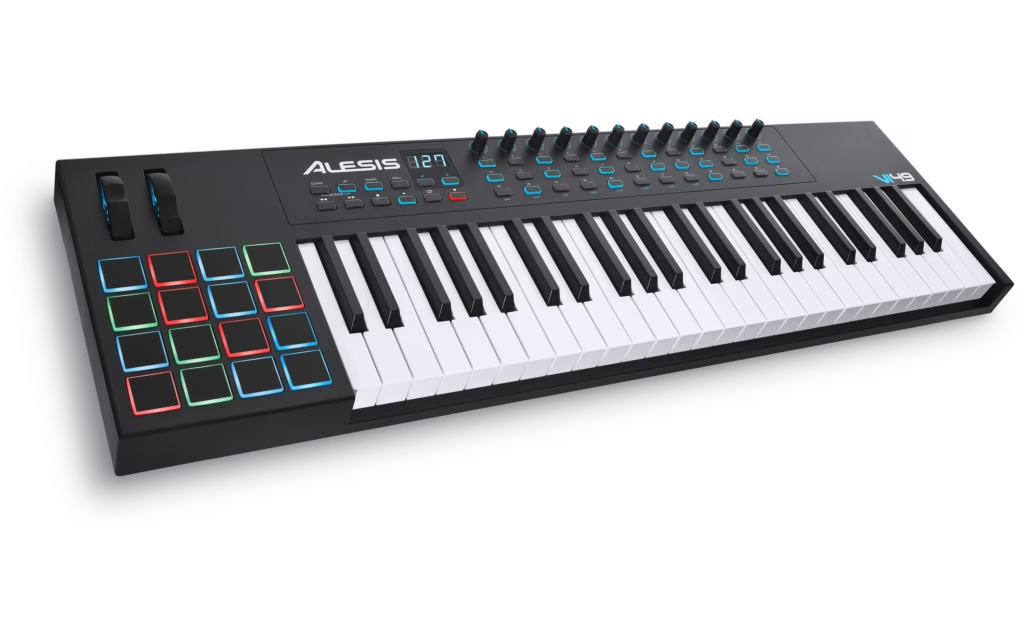
Squeaky Alesis Keyboard Key

How to fix a squeaking key on the alesis vi49 (and presumably others as well)

Compared to some other gear-repair posts I’ve done, this one is really pretty basic, but as someone who is often trying to repair something for the very first time, I always appreciate if I can find out ahead of time what’s involved and how difficult it is. So in that spirit, here’s a very short how-to.

The good news is that this is a very simple fix: it will take you less than fifteen minutes. All you need is a small-ish Phillips-head screwdriver and some WD-40.

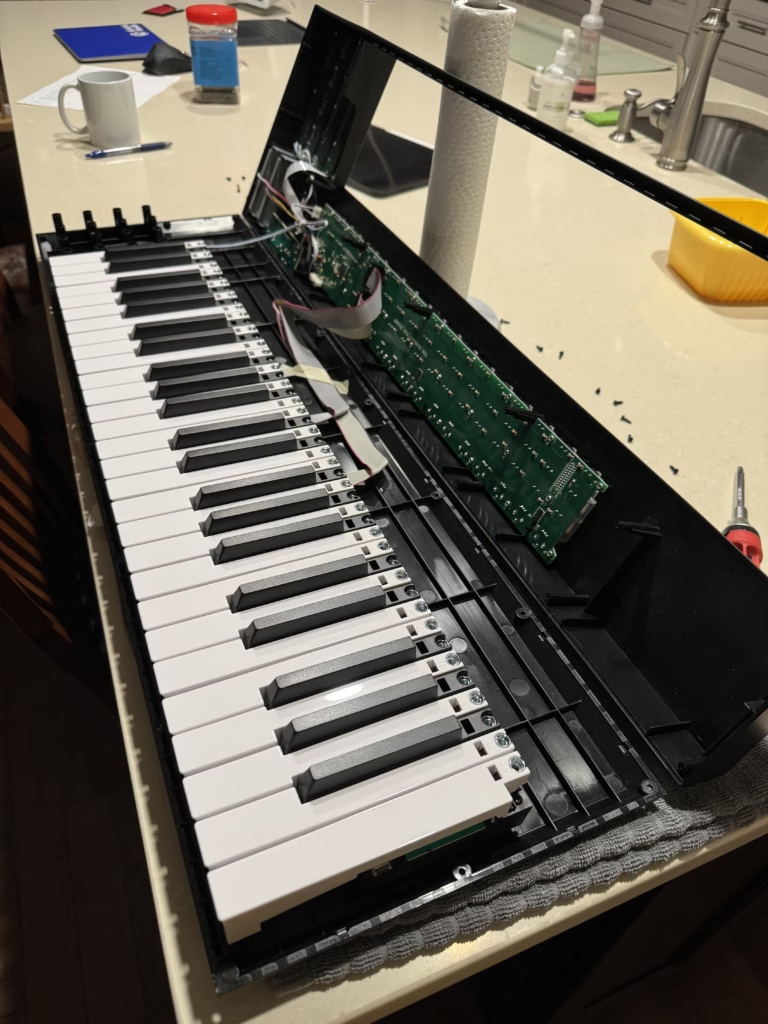
Step 1 (of 3) is to open the case. You do this by unfastening all of the screws on the bottom side of the keyboard. Actually, you probably only need to remove the screws along the perimeter. there are a half-dozen or so screws more in the center of the keyboard, but it doesn’t seem that they connect to the upper housing. I did remove all of the screws and didn’t have a problem, but I’d try just starting with the perimeter screws because I think that’s all you need.

All of the screws are of the same size and length, so you do not need to keep track of which came out of which hole.

Once the screws are removed, lift the housing from the front. Pay attention to the two ribbon cables that connect the lower housing to the upper housing. You do not need to disconnect the cables; they are long enough that you can lift the upper housing with the cables in place.

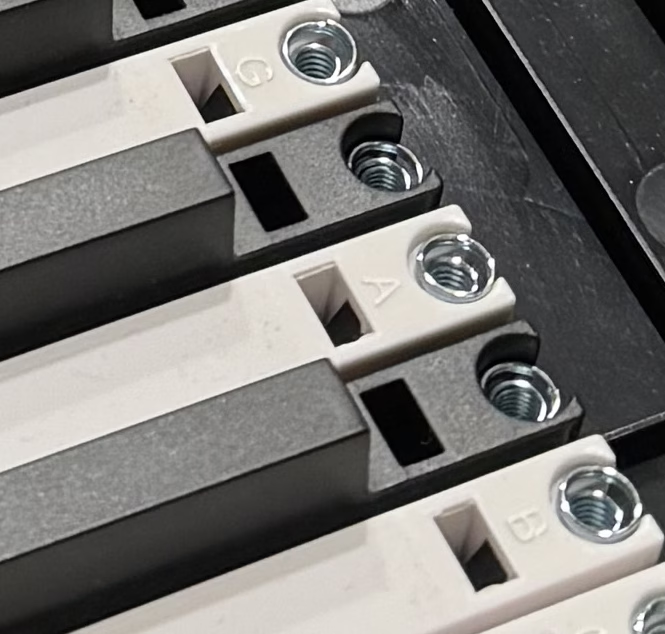
The squeaking sound you hear when you press your problem key is caused by friction between the key and the spring that provides resistance to your playing (and, of course, returning the key to its starting position). A tiny bit of WD-40 sprayed on the spring should quickly resolve the issue.

Play each key repeatedly and check to make sure it’s not squeaking. If it is, give it a shot of WD-40. Do not overuse the spray.

When all the keys are quiet, lower the upper housing and replace all of the screws you removed in step 1. That’s it. I did have a squeak return after about a year, but this process is so easy I did not really mind repeating it. I suppose you could consider other lubricants if this fix doesn’t last long enough for you, but I have no specific recommendation.

Best of luck!

Space:1999 Reboot – Keep David Kano

Space 1999 is ripe for a reboot, and here I will be discussing which aspects of the original show should be kept and which should be discarded. I won’t be going in any particular order (of importance, for example), but I hope to cover all significant aspects of the show as I go.

Just a month ago or so, the number of surviving cast members of the show, already a lamentably small number, decreased by two, with the passing of Prentis Hancock and Clifton Jones within a few days of one another. Jones is the man who personified what, in my humble opinion, was a terribly underserved character, and one I feel should absolutely be included in the reboot.

I’m speaking, of course, of the great David Kano. After Koenig, Russell and Bergman, Kano is clearly the most important character to the show (no offense intended to Alan Carter!).

Clifton Jones as David Kano
David Kano, as portrayed by Clifton Jones

Kano’s on-screen career begins in Season 1, episode 2 (a very similar character, Ben Ouma, appeared in the pilot) and continued on through all of the remaining episodes of the first season (or series, as they call them in the UK). After the first season he, along with the likes of Bergman and Morrow, were victims of a purge of characters that new producer Fred Freiberger found not particularly likable, and was never heard from again. Rather, in season 2, it was new arrival Maya that seems to have replaced both Kano and Bergman, which is truly a shame since it was the interplay between those two characters that held so much storytelling promise.

Kano operates as the chief “Computer Operations Officer” on Alpha. More than this, he represents technology in the series, separate and subtly different from science, which is generally Bergman’s purview. While this may not seem like much of a distinction, in this show it positively is.

For illustration, let me contrast the Kano / Bergman relationship with the Spock / McCoy relationship from Star Trek. In the latter, Spock represents logic and McCoy represents emotion. I think that as that show developed, the writers thought that the two would be equally balanced, with Spock’s logic-based approach prevailing more or less half the time and McCoy’s humanist, emotional outlook being the right one the other half. In practice, it was never so balanced. Spock’s logic was shown to be the right course nearly every time, and McCoy, sadly, just watched from the sideline and carped about the application of logic to the situation (even when it seemed to be the obvious thing to do).

With Bergman and Kano, though, there was great promise for a much more balanced dichotomy. Both men embraced logic (which, in a science fiction/fantasy show, is probably the right side to be on), but for Kano logic was embodied by technology, namely the computer. He had full faith in the computer and would come to its defense when it was criticized (“Computer is not a crystal ball!”). Bergman, on the other hand, was far more willing to embrace the metaphysical or even the spiritual. Bergman had far less confidence in computer because he felt that the scope of what humans really knew or understood was much less than a person like Kano would like to admit.

This worked on Space: 1999 in a way that it would not work in Star Trek. Even though both shows were pretty firmly in the science fantasy genre, employing things like ESP, beings with god-like powers, telekinesis and other elements that have no real scientific basis (that we know of, at least!), Star Trek always tried to explain such things in scientific terms (the origin of “technobabble”) while Space was content to leave mysterious things mysterious. This put Bergman on even footing with Kano in a way that McCoy was never on Spock’s level of credibility.

Look no further than “Black Sun” to see how wonderful the dynamics between Bergman and Kano can be. In this episode, to save power, most systems on Alpha need to be shut down, and this eventually includes the computer as well. Kano is both indignant and horrified by the idea, as he can’t imagine anything more important to their survival than computer. Bergman, on the other hand, can only be described as bemused by Kano’s attitude toward something that is not going to be able to help them avoid being swallowed by a black hole.

The distinction between Kano, who embodies science through technology, and Bergman, who embodies science but not necessarily technology, provided a great opportunity for 1999 writers to comment on mankind’s relative ignorance. This is important for the series, not just because of the presence of the Mysterious Unknown Force (or “MUF”, to be discussed in a future post) but also the fact that in general, a whole lot of spooky, unexplained things happen out in space. While the show can be fairly criticized for failing to be faithful to some very basic scientific principles (shockwaves in space, for one, and let’s just not talk about the physics of the Breakaway event), I think we are behooved to allow ourselves to imagine that there’s probably more we don’t know than that we do know, and that would probably only accelerate as we traveled deeper into space and experienced more.

So, keep David Kano, the prickly computer operator whose lack of people skills so perfectly mimics many of the technology people we all know, and let him face off against Victor, who is going to always be coming at him with wild, extra-scientific theories (which, if the writers are doing their jobs, will be wrong as often as they’re right).

The Rise of AI-Generated WordPress Comments

It feels like the era known as Web 2.0 is drawing to a close. Never quite what it was cracked up to be, nevertheless the Web 2.0 age was probably the apotheosis of the vision of a worldwide network of people freely exchanging ideas instead of the one-way producer to consumer model that came before and will come after.

While I’d prefer that this site be changing the world, the reality is that it must change with the world, and by that I mean this:

It is time to close comments on this site.

I am a little disappointed to have to take this step, as I did enjoy getting feedback from people all over the world, even if it meant sifting through a lot of bot-generated comments.

Recently, though, a new kind of comment spam has emerged, the AI-generated content, and that’s going to be a deal-breaker for website administrators.

For as long as there have been comments on websites (WordPress, in this case), there have been bot-generated comments. There are various reasons why bots want to comment on your articles, mostly involving planting links. For WordPress specifically, there is an administrator setting to allow users to post comments without moderation if they already have an approved comment, so the strategy to exploit that is to have one flattering comment get approved, and then follow it up with whatever self-serving junk you want to post.

So site administrators like myself get a lot of “Great post! I wish other people had such great content! I’m going to tell all my friends!” Just flattery and platitudes, and I’m sure it works, because who doesn’t want to hear about how wonderful their stuff is?

The new AI-generated comments take this idea one step further. Instead of generic praise, these new posts contain generic praise augmented by specific information from the site.

This new AI-powered bot will look at the content of the site and glean the topic, then pepper its remarks with this in formation. Consider this comment from “Fortnite Android”:

Great comparison! I personally lean towards Zwift for the interactive elements and virtual races, but I can see the appeal of Peloton’s community and guided classes. It really depends on what you’re looking for in your workout experience!

So, the comment shows that it understands that this article is a comparison between Zwift and Peloton, and adds a couple of general bits of information about each. This more effectively masks the fact that there is no actual thinking behind the comment and starts to look like an actual thought from an actual thinking person.

This is only going to get worse. I can easily see the next wave of comments being opinionated (instead of just rehashing information) and even engaging in existing comment threads. Before long, we will have bots vs bots discussing my posts, using facts and figures (some no doubt made up) from other websites, which themselves are probably generated by bots.

I took a look at the WordPress catalog of plugins to see if anyone was taking this on, and what I found was not encouraging. The AI-powered plugins that I found were all written to provide AI-generated responses to comments. So it seems that the emerging strategy for dealing with this new overload of worthless comments is to just automate responses, treating any real commenters to the same anodyne replies. I can see it now: “Great comment, very thought-provoking. I wish more people had the power of insight that you do. Great point about [random bit of the comment], I’ll have to consider that for the subject of a new post!”

So, until and unless there emerges a legitimate tactic for battling this, I’ll be turning comments off for my posts. If you have anything you’d like to comment on, please contact me through the contact form. I do actually read those, and will include your comments as updates to the posts of I fell the general audience will benefit.

Thanks.

PS: I may turn comments back on from time to time as I evaluate anti-bot software, we’ll see how it goes.

Space 2099 – The Reboot That Never Was

A few years ago, fans of Space: 1999 were given some hope that the show was getting revitalized when a sizzle reel appeared describing “Space: 2099”, a reintroduction of the series. Now, this was nothing like the Ron Moore reboot of Battlestar Galactica. Rather, it was more like George Lucas’ enhancement of the original Star Wars trilogy: updated effects and a few editorial changes.

Space 2099 was intended to be a re-editing of the original series, with changes made to modernize it. There were no new episodes or new characters, but rather a reworking of the classic series that would hopefully be more appealing to modern viewers.

Although Space 2099 was merely a polishing of the existing material rather than a continuation or a “reimagining” of the show, it is still informative to take a look at this effort because the team behind it very clearly laid out the changes they planned to make. These changes includes:

  • Updated special effects, which obviously have advanced a great detail in the five decades since the series was produced.
  • Re-ordering episodes to emphasize certain through-stories, and the introduction of “previously on” segments to call attention to people and themes that were referenced in the past. While it’s true that the series was not necessarily aired in the order the creators originally intended (as some episodes required much more post-production than others), there isn’t an established logical order for the episodes, either. While some character development and relationships can be said to change over time, I’m not sure how much intentional change we really see over the course of the series, but maybe there is more than met my eye.
  • The introduction of a wormhole that the moon would enter during its initial breakaway from Earth’s orbit, intended to help explain how the moon made it out to deep space in the first place. This is an attempt to address one of the most persistent criticism of the show — that the moon makes for an unlikely spaceship. (Believe it or not, having the moon blast out of Earth orbit was not part of the original plan for the series. I’ll explore this aspect of the show in a future post.)
  • Tighter editing of the episodes for pacing purposes. While Space: 1999 was a bit slow by American standards in the 1970s, just about every show and movie from that era seems very slow paced when compared to their modern counterparts.
  • Edits in dialog to alter time references, to set the revised series in the year 2099 instead of 1999. For example, instead of saying “back in 1987”, the video is edited so that the speaker seems to say “back in ‘87”. In this writer’s opinion, this seemed superfluous, but it was nevertheless a point of emphasis for the 2099 team.

Ironically, it seems that the Space 2099 project died because it competed with a full-on reboot of the franchise (which, clearly hasn’t happened yet.) It’s a shame that this work was never completed, because it had the chance of inexpensively revitalizing interest in the franchise and probably increasing the chance for a sequel or reboot to happen in the future.

After digging for some time, I uncovered this message from Eric Bernard, who was spearheading the project. This message was posted on or before February, 2009 on the now-defunct project website, space2099.tv.

Dear Space: 2099 supporters, I am sad to announce that as of November 3rd, 2008 all of our Space: 2099 videos will no longer be available with the exception of the Space News. As many of you know, this website was produced to be shown to Granada/ITV as part of a proposal for an enhanced version of Space: 1999 to reignite the franchise. We got their attention all right, but unfortunately they’ve let us know that they’re currently not interested in our concept and asked us to remove all the videos with Space: 1999 footage so that there would be no conflict with their distributors.

I want to thank all of you for your great support!

… I believe that Space: 1999 would have benefited from this concept as it would have been a perfect platform for a new series. I still have all kinds of ideas that haven’t been shown here that could have created an unprecedented event in sci-fi television. I have been told that Granada is looking at some Space: 1999 proposals at the moment for a FULL REMAKE of the series. However, since 2002 I’ve been in contact with the owners of Space: 1999 and each time I got the same reply as this one. As you all know, no remakes have been done to date.

Assuming that Space: 1999 someday does get the full reboot/reimagining treatment, what are the most important elements of the original show to keep?

Stay tuned…

How to Reboot Space: 1999

Introduction – Why even reboot Space 1999?

September 13, 1999, twenty-five years ago today, is a milestone date in the world of science fiction. It is the day that radioactive waste on the moon exploded, blowing the moon out of Earth’s orbit and into deep space, taking Moonbase Alpha and its 300 or so inhabitants with it. The events of that day are chronicled in Breakaway, the pilot episode of the series Space: 1999.

At the time of the story’s telling (October 17, 1975, to be exact), 1999 was the near future, far enough that we could imagine that mankind had moved on from the space age’s infancy, but not so far into the future that the culture or technology of Moonbase Alpha seemed strange to us. Indeed, the Alphans (as the moon base’s inhabitants called themselves) were far less perfect than the explorers of Star Trek, a show set nearly two hundred years further into the future.

“Cult Favorite”

Space: 1999 still has a cult following nearly fifty years after its debut, despite lasting only 48 episodes (too few to be of interest of syndicators, who largely prefer a show to have at least 100 episodes) and having been produced by a small studio best known up to that point for a series of short-run series featuring marionettes. In our age of remakes, reboots, and sequels, many series are getting a new lease on life (for just one example: silly sci-fi pioneer Lost In Space returned as an edge-of-your seat [adventure series] in 2018), but not all do (I’m looking at you, Firefly!). Whether or not a show gets a chance to return from oblivion is dependent on many factors, some having to do with the quality of the source materials, and others having to do with financial considerations such as who owns the intellectual property.

In the following weeks, I plan to present a series of articles on the topic of How to Reboot Space: 1999, discussing which characters, concepts, and plot devices to keep, and which need to be left behind. I will also discuss Space: 2099, the closest it seems the series has come to a reboot to date. Before launching into details, though, it is worth presenting the case for rebooting the series at all… to answer the question of what makes the show worthy of being revived.

Almost the greatest Sci Fi show ever

Ask people to name the biggest Sci Fi franchises ever, and although they may differ on many of the items in their list, it’s a good bet that Star Trek and Star Wars will occupy the top two spots. Star Trek debuted in September of 1966 and ran for three years, receiving modest interest that famously grew for a decade until returning in motion picture form in 1979. Star Wars opened in late spring 1977, and it is impossible to overstate the impact it had on the world of sci-fi.

Right in the middle of the 1970s, as Star Trek was building steam and Star Wars in development and production, Space: 1999 ran for two seasons in 1975 and 1976. Chronologically, it would seem to have been in the right place at the right time. So why did Trek and Wars become immensely successful while Space: 1999 remains a “cult favorite”, not quite forgotten but always discussed in the past tense?

There are several reasons why Space: 1999 seems to have just missed its chance for greatness, but probably the most significant factor was timing, which was just a tiny bit off. Had the show gotten a third season, it would have been running just as Star Wars hit the big screen, which would no doubt have boosted its profile. (Indeed, it was the incredible success of Star Wars that helped Star Trek: The Motion Picture get the green light, in one of those “what have we got that we could make into a movie” moments at the studio boardroom.) Alas, the very high production costs and a surprising apathy in Britain (where the show was developed and filmed) meant that Space: 1999 did not quite last long enough to be top-of-mind when Star Wars kick-started the development of shows like Battlestar: Galactica and Buck Rogers.

Another factor working against it is that Space: 1999 never found its stride. For it’s entire existence, the show was being pushed and pulled by external forces, beginning with its origins as a spin-off from another show that was re-worked and rushed into production as a new series and culminating in a complete overhaul between seasons one and two in an attempt to broaden the show’s appeal to American audiences. Many shows — Star Trek’s sequel “The Next Generation” comes to mind — take a few seasons to emerge from the chrysalis stage, and that never happened with Space: 1999.

Surely there were other challenges, too, but I’ll discuss those in future posts when considering what elements of the show should stay and which should go. But first, we should consider Space: 2099, the last, most recent serious attempt to revitalize the franchise.

Gutenberg vs. Divi, Round 2

Recap of Round 1

About two years have passed since I wrote about my first experiment with jettisoning Divi in favor of Gutenberg for this site. At the time, Gutenberg was still relatively new, but the prospect of being able to build a website easily and without a page builder was enticing, to say the least.

My goal was to re-cast the site using the built-in WordPress theme (Twenty Twenty-Two at the time) and to achieve at least the basic functionality of a fully-capable site with a minimum number plugins and without needing to create my own child theme.

The experiment didn’t go well or last long. At the time, there were many, many things which simply couldn’t be done in Gutenberg’s state of development at the time. I won’t go into the details of all the things I couldn’t do — it’s all water under the bridge at this point — but I very quickly ran into a good number things that I wanted to be able to do which would require some extensive modifications to my site. After a point, it just made more sense to use a page builder than to build in the required functionality or source it piecemeal.

Why try again?

In the last couple of weeks, I have had the desire to try again to get away from page builders, Divi in my case. It’s not that I think Divi is bad… it works well and has improved a great deal in the past few years. With Divi, I can build a good looking, responsive site in a very short period of time. Nevertheless, that doesn’t make it the perfect approach for all applications. The page builder approach has some drawbacks.

  • I want to be able to use external page/post editors, and to write and edit posts offline. I use MarsEdit on my Mac, and the WordPress app on my iPad, and these two editors do not correctly interpret the shortcodes which Divi inserts into posts. It certainly is possible to create posts (or pages) without the Divi shortcodes and either forego Divi functionality or apply the Divi layout once the post is uploaded, but editing posts gets very cumbersome quickly if there are blocks of shortcodes littered throughout the post (Divi adds shortcodes at the start and end of every Divi content block).
  • Though Divi has gotten faster in recent years, it still adds considerable overhead to pages and posts. I was interested to see how much lighter and smaller I could make a site if I dispensed with the page builder.
  • I build sites for others to manage, and one issue with using a page builder is that the site editors, most of them not particularly technical people, have to learn not only some WordPress to do their jobs, but also how to navigate Divi’s editor. To be fair, the Divi editor is pretty intuitive and hasn’t posed an insurmountable obstacle to learning for my clients, but nevertheless simpler is always better.

Converting from Divi to Gutenberg

The first thing I did to switch from Divi to Gutenberg was to change the theme, in my case changing from Divi to the base theme (Twenty Twenty-Four). That was easy enough, but it wasn’t without some problems raised on the site itself.

Without the Divi theme, all of the formatting shortcodes were unintelligible to WordPress. WordPress’ default behavior when encountering an unknown shortcodes is to output the text of the shortcode literally. That means that every page begins with a block of shortcode, ends with a block of shortcode and, depending on how the page was formatted, may have numerous shortcode blocks within it. Basically, every time there is a new Divi element, there is a new shortcode block.

Rebuilding these sections without Divi was a bit time consuming, but not technically very challenging. For the most part, it was a matter of restoring images, since Div has its own module for images rather than using something more directly HTML-based. The same is true for videos or other embedded content. Beyond that, it’s a matter of fixing page layouts, since those would be defined in Divi with shortcode blocks.

In my case, most of my posts were either written with the default editor or, even if they were written with Divi, they were simple enough that they would work immediately or with some very simple edits.

Filling the gaps

A few other elements of the site needed more work than just deleting shortcodes and adding back missing media items. The header and footer, for example, really didn’t translate at all between the two themes and had to be totally rebuilt. Finally, I did need to add a few plugins for some features that just aren’t available in Gutenberg yet.

  • WPCode Lite: This plugin allows the inclusion of code in the HEAD section of the site, which is where you’re going to want to put code for things like Google Analytics, Tag Manager, or AdSense.
  • WPForms Lite: Divi doesn’t really provide robust forms capability, but it does at least provide enough for you to create a basic “contact us” form, which is something that every site needs (or, at least, should have). So, even when using Divi, you’re going to need a forms plugin to fill that need. Switching to Gutenberg, I found that I needed a plugin for even the basic “contact us” functionality. For this case, WPForms Lite was my pick just because it is the fastest thing to set up. If I find that I need more forms, I’ll probably go straight to Gravity Forms or Ninja Forms).

Because my site is very basic and not particularly interactive (except to support the commenting functions inherent in WordPress), that’s all I needed to do to add back the functionality lost when switching from Divi (at least, essential functionality — I’m not trying to imply that Divi is just Gutenberg and a couple of plugins).

Final Thoughts

This time around, the conversion to Gutenberg from Divi was much more successful. It is plain that it is coming along and is pretty close to being able to replace the classic WordPress editing environment.

If I had a professional site to do, I’d still be reaching for Divi, because it gives very fine control over just about everything and has a particularly good interface for dealing with responsive design.

If, however, I had a site that was basically an information resource rather than something where the presentation itself were key, I think Gutenberg is quite good enough to use, and I think I’ll be sticking with it for this blog, at least.

Zwift Play and the Wahoo Kickr Bike

(Originally posted June 18, 2023, with updates at the end)

If you own the Wahoo Kickr bike, you already have handlebar-mounted buttons for things like using power-ups, turning left and right, making u-turns, etc., so you might be wondering how much value there might be to adding the new Zwift Play controllers to your system. Well, I did, by rationalizing the $99 introductory price as a pretty small upgrade after the $3000+ cost of the bike. (Another victory for mental accounting!) Anyway, here’s one user’s story:

The Zwift play controllers are two controllers which attach to your handlebars and provide gaming console-like buttons (the classic up-down-left-right and “A-B-Z-Y”, because if your company name starts with Z you need a Z button more than you need an X button) as well as broad paddles you can push or pull. So, it’s eight buttons (that can differentiate between press and long-press) and two two-way paddles to add to the various buttons already on the Zwift bike’s handlebars.

Installing the Zwift Play paddles on a Wahoo Kickr Bike

Installation could not have been easier. They go on just like in the video, no spacers needed. And the fit is snug, too… on my bike at least there was less deflection in the controllers when pushing a button (though maybe I just have a softer touch than the person in the video). They do a pretty good job of keeping out of the way, though you should consider your grip. Riding on the hoods is fine but sometimes I put my hands just behind the hoods, and it is just a little harder to get my thumbs out of the way when I do. I think I’ll adjust, it’s not enough of an annoyance to be a deal-breaker.

Zwift Play quality of workmanship

The Zwift Play controllers seem nice. The have good heft to them and it doesn’t seem like they’re prone to break down soon. The buttons do seem a bit stiff for my taste. They look like X-Box buttons, but they don’t have nearly as good a feel. This is probably due to the rubber membrane that sits over the buttons, and since I’m a lot more likely to sweat on my Zwift Play controllers than I am my X-Box controller, I think it’s probably a good trade-off.

The Good

Having the Zwift Play controllers on my Wahoo Kickr bike eliminates just about every need I had to touch my iPad (or pick up my Apple Remote) during gameplay. Hitting the “up” button would call up the in-ride menu, and navigation from there was pretty easy using the left-right buttons to change options and the “A” and “B” buttons for OK and cancel, respectively. There are also a couple of actions such as returning a “ride-on!” which I was never able to do using the iPad or Zwift Companion interfaces. 

Pulling either of the handlebar paddles in the outboard direction activates steering, and it does seem to me to be smoother than using the buttons on the Wahoo Kickr bike. Steering is still a feature I don’t use much in Zwift, but it works better now, and who knows? If enough people adopt the Zwift Play then the developers might integrate steering more into the game. Since steering by button or paddle is still the part of the bike interface that is the least analogous to its real-world counterpart it still feels like a weak link in the interface, despite being the best implementation of steering yet.  

Pushing the handlebar paddles in the inboard direction activates braking, and this braking is different from how it’s implemented on the Wahoo Kickr bike. On the bike, using the physical brake handles, the braking mechanism slows the flywheel on the bike, but that doesn’t translate into braking in the game. Zwift doesn’t care how fast your flywheel is turning, just in how much power you’re applying to it. So coasting and braking (using the Kickr bike’s brakes) are the same thing.

The Zwift Play brakes, on the other hand, brake the in-game bicycle. This could be immensely useful for those time when you are dropping your pacebot, which I unfortunately seem to do at the top of a lot of hills). 

If you’ve been using your computer as your Zwift interface, you probably could do all of this all along, but for people like me who have been playing on an iPad or an AppleTV, it’s like a brand-new feature!

(I also noticed during my first ride that Zwift finally did add the “teleport” option, which I have been extremely eager to have. It’s not related to the Play, as far as I know, but I was pretty stoked to see it)

The Bad

I can’t say that there’s anything I’d call “bad” about the new Zwift Play controllers. Using them does not preclude you from using the buttons on the Wahoo Kickr bike, so if you’d rather hit the bike’s button for a power-up, you still can. I’ve mentioned the stiff buttons and the slightly intrusive mounting, but these are not huge issues.

What’s Missing

What I really want is to be able to set my own commands for the Zwift Play buttons. There is some overlap between the Play and the Kickr bike, and by having both you have two buttons for power-ups, two for u-turns, and redundant controls for steering (though, as I mentioned above, the Play does it better). Let me re-map one of those buttons so I could quickly look behind myself to see who’s behind and catching up. That would be sweet.

Final Word

I am pretty excited about the Zwift Play. I didn’t have the effect on my Zwifting that getting moving from my bike-on-a-trainer to the Wahoo Kickr bike did, but then again it’s only $100. I hope that this will open the door to more users adopting it, because if a critical mass of Zwift riders have steering (and braking, for that matter), it would open the door for Zwift to making a bigger commitment to those features in the game. It’s great that Zwift can be played on many different setups, but it does mean that game development must necessarily be focused on the lowest common denominator. If the Zwift Play becomes part of people’s base setups, it will create opportunities for everyone.

Final, Final Word (update, May 2024)

Well, it’s about a year later, and I have to say that I’m not using the Zwift Play anymore. For my setup, it just didn’t add value. The Kickr Bike provides a lot of the same buttons (turning, power-up, etc) and I because I ride with the Zwift companion on my phone on my handlebars and because the iPad I use for display is within reach, there just isn’t much I can do with the Play that I can’t already do elsewhere. I think braking might be the only thing that the Play does that the Kickr Bike doesn’t (the Kickr Bike has brakes but they don’t affect the game — rather they affect the actual flywheel) but I can’t recall the last time I wanted to use my brakes in the game. Maybe something technical like Repack Ridge would benefit from it, but in my humble opinion that’s all still a gimmick. The Play’s turning controls are a little more to my liking than the Kickr Bike’s buttons, but that’s just not enough to make it worth it.

In the end, I found that the Play’s mounting position got a bit in the way when I was riding. In particular, when riding uphill it became a little bit of an annoyance figuring out where I could put my hands so that my fingers could grasp the handlebars comfortably.

I still think the Play is a nice bit of gear, and if I was still using my road-bike-on-a-trainer setup that I had before I moved to the Kickr Bike, I think it would be a terrific addition. Since so much of the functionality is duplicated on the Kickr Bike, though, in the end I just wouldn’t recommend it for those users.

Peloton Guide Review

The Peloton Guide is far cheaper than some other products in its category (for those with the “all-access” Peloton plan, at least) but it often feels like it’s still version 1.0.

A few months ago I purchased the Peloton Guide. I had been taking some weight training classes, and was intrigued by some of the things the instructors said in the class, namely that if I had the Peloton guide, it would track reps and keep track of how much weight I was actually lifting. I checked on pricing, and found that it was a one-time cost (about $200, if I recall), with no additional monthly cost as I already had the “all-access” plan. (Important note: if you don’t have the “all-access” plan, there is a monthly cost to owning a Peloton Guide, and that changes the value proposition immensely. I like having the guide and use it several times a week, but would not be keeping it if it had its own subscription.)

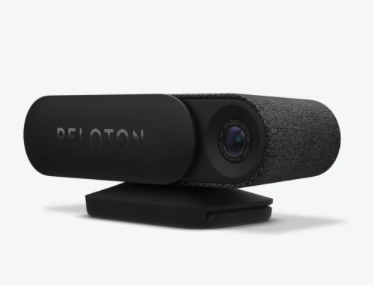
The guide comes in one box and consists of two devices, the camera and a remote. The camera plugs directly into your TV via HDMI and doesn’t require a smart TV or any particular apps or intermediary devices. Calibration is quick — just repeat a few key phrases and you’re good to go.

You get a remote, but it seems that just about every command can be performed using voice as well. In practice, I only use the voice commands for in-class actions, such as changing the weight I’m using for an exercise (I do not have the Peloton Rack, which apparently automates this as well). I should mention that a second user in my home had a lot of trouble getting the guide to respond to her voice, but this seemed to clear up after she re-ran the voice control set up.

There are videos online from Peloton on how the Guide works, so I’m not going to go into all of the features. Rather, I’ll just give you the highlights and lowlights of the user experience. Spoiler alert: I’m still using it, so all-in-all I have to give it a positive rating, but my wish list is also pretty long.

What the Guide does well:

The one thing the Guide does best is act as a commitment mechanism. It’ll keep track of your workouts, and will set a schedule for you based on your preferences (for example, the number of days in the week you want to train). For some people, I think, this might be just the thing to get them into a routine.

The Guide will also set a schedule, so you can tell it that you want to work out, say, four days a week, and it will set up a new four-workout set each week. I appreciate having that done for me, though I do not know how personalized the recommendations are. It’d be great if it could make some sort of analysis, based on my past performance, to tailor the workouts, but I don’t think it’s likely doing anything nearly as sophisticated. I imagine that most everyone who selects the same number of workouts is recommended the same mix, but I don’t know that for sure.

What the Guide doesn’t do well:

The Guide certainly has some room for improvement in some areas, and the thing I would put at the top of the list is rep counting. There are a lot of instances in which the Guide counts extra reps. To give one example, say you are doing a dumbbell press (pushing a dumbbell from your shoulder to over your head). You do a set of them and they’re counted — all good. Now, you are done, so you lower the weight to your waist or to the floor and the counter counts that as a rep. This is a problem, as far as I’m concerned. I want to be able to return to this workout in, say, a month, to see if I’ve improved, and the difference between being able to do ten reps of an exercise and being able to do eleven is not insignificant. Some exercises are even worse — pushups sometimes are counted wildly, maybe because the motion isn’t all that dramatic and the camera has to see your whole body, but pushup counts (and floor exercises in general) tend to be very inaccurate.

Given that the Guide seems to have a lot of trouble with rep counting, it doesn’t even attempt to try in a lot of cases. Combination moves (say, a snatch to a press) generally aren’t tracked. Often you just see “timed activity” in the display when the motion is just too complicated to track, and that happens pretty often.

The other way in which I think the Guide is a bit of a disappointment is that it doesn’t do anything to correct your form. It does let you see yourself on the TV in a window so you can see your own form and compare it to the instructor, but you can only do that when you’re facing the camera. For many exercises, you’re asked to turn to the side (90 degrees to the camera), so facing to the side and then looking back to the screen is awkward. Additionally, it’s not so easy to look at the screen when you’re on the floor doing floor exercises.

Other limitations:

The biggest limitation, it seems, to the Guide is that everything is either a floor exercise or a dumbbell exercise, so it’s not possible to get an equally good workout for each muscle group. Specifically, exercise in which you’re asked to pull down are next to impossible. Back exercises generally have you leaning forward from the hips, and you could reach the limit of what your lower back can stand before you reach the limit of your upper back muscles to work out. Lower body work tends to be various forms of squats, either one-legged or two-legged. You can get a good workout, to be sure, but ultimately it seems like a workout might contain two or three exercises that work the exact same muscles.

After workouts, you can see some neat graphics that show what muscle groups you have been working out. I think this is really based on the content of the exercise program rather than any feedback from your actual workout. It will tell you how many reps you did and how many targets you hit, but I have yet to figure out how to benefit from that information. On a workout by workout basis you can compare your current effort to a prior effort, but to do so you need to take the exact same workout as before. It would be more useful if the system were to break down by exercise and report on trends on that basis rather than doing comparisons by workout.

Final word:

The Guide works for me because I only had to pay the up-front price for the device and I already have the dumbbells needed. The workout scheduler does create a compelling commitment mechanism. I am hoping that the software will improve over time, that rep counting will become more reliable, that the algorithms used to analyze my progress and select workouts will improve (not sure it’s do any of that today) and that the Guide will gain the ability to help me perfect my form. Will that happen? Hard to say. I do not have any visibility into how much of a priority the Guide is for Peloton. The company’s post-pandemic troubles have been widely publicized, and I’m sure they are being extremely circumspect about where they are spending their energies in terms of building out new capabilities in their products. It would not surprise me if the Guide doesn’t grow beyond what it is today, but if it doesn’t, there is a lot of room for a competitor to seize the in-home weight-training market.

Madden and Chat GPT

For something over ten years, I was something of a Madden fanatic. I eagerly awaited Maddenoliday every year, and even those years when my Eagles were not contenders, I rooted for them every week because I knew that if the IRL Eagles did well, the Madden Eagles eventually would, too.

If you don’t know about Madden football, well, you’re probably not even reading this. But in case somehow you are reading it anyway, it’s important to understand that the players in Madden are modeled from the actual players. Players move on and off the Madden roster as they join and leave the real teams, and each player has maybe a dozen different statistics (speed, throwing power, tackling ability, etc) that determine his performance in the game. Other sports games do this, too, but for me Madden was the sports game for a long time.

Although it continues to be a standout game, I have to say that I did ultimately fall out of love with Madden, to the extend that this year — for the first time in maybe fifteen years — I didn’t buy the new version. Mostly it has to do with the complexity of the game. If you want to be really, really good at this game it takes a very long time to learn all of its nuances. I mean, it’s incredible that you can control things like stunts on offense and shading for individual defenders, and the incredible level of granularity you have with your pre-snap adjustments. (It’s my understanding that many elite players basically call the same few plays over and over and do all of the adjustments before the snap.) In reality, no single person has the responsibilities that a Madden player has, and eventually it got to be too much.

There are some other reasons that I lost interest in Madden, but one that I’d like to speak about here is one that I hadn’t thought much about after giving up the game until recently. With “artificial intelligence” all the rage now (though more and more it is more accurately being called “natural language modeling”), I began to try out Chat GPT and was reading a lot about its potential for generating content (like, I suppose, a blog post, yikes!). The more I learned, the more I began to remember Madden, and here’s why…

One of the disappointments I had with the game is that, for all its complexity, it cannot model the real world in one important way: imagining things we haven’t encountered yet.

Say my team has just traded for a backup quarterback who has been languishing on some other team’s roster, holding a clipboard and never seeing any game action. I happen to know this QB and I think he’s a diamond in the rough, far more talented than anyone gives him credit for. On my team, in combination with the other players on offense, he’s going to be magic: far better, in fact, than the starting QB we have now.

So, do I shuffle the Madden roster so that the kid can lead the team? No chance! Because the game may be called Madden, but the governing ideology comes from Bill Parcells, namely: “You are what your record says you are.”

If your player’s stats are lower than some other player, then they’re not going to perform as well. Period. Now, there is a little bit of nuance there, because players are a combination of stats and not one single number (though there is a stat called “overall” that does a good job of summarizing), but nevertheless, it’s a straight-up numbers game. In some years, Madden’s publisher tried to get around this by introducing the concept of hot and cold streaks, as well as randomly giving some players a little bit of a boost or handicap (called “nerfing” in game-speak) to make it a little more mysterious who might be the best pick for any given situation.

I do think these were great ideas, but they generally only applied to single games, so without any more information it would still be unwise to start a player that you just felt was underestimated over one that you might feel is overrated. In Madden, you are what your record says you are.

So, what’s the connection to my Chat GPT adventures? I was having lunch last week with a friend who works for a company that, among other things, is working on detecting ai-generated content, and he shared with me some of the characteristics of the work product of these applications. It occurred to me that the great weakness of these models is that they are unable to actually create anything. They can only put together combinations of things that have already been done.

Now, it’s true that many (if not most) inventions are just combinations of prior inventions and that very few things are created completely out of whole cloth. In that light, perhaps the ai applications limitation that it can only put together elements that it has ingested from prior work doesn’t seem like such a problem. But the thing is that the ai programs don’t really understand the things it’s combining. Worse, it creates the illusion of intelligence by combining the most commonly combined things. Ask Chat GBT a question, and it will probably give you the right answer, not because it actually knows the answer but because it can see what the most common answer is and give you that, assuming (and trusting) that is the correct answer. Write enough articles (or, say, post in the comments of your favorite blog) asserting that the Earth is flat, and these chatbots will ultimately agree with you.

I have no idea how Madden could possibly solve the “diamond in the rough” problem it has, absent the invention of a Time Machine. The developers already face a huge problem when they try to calculate the stats on rookies (ie: that franchise quarterback you just drafted but hasn’t played a down of football yet), with equal numbers of people complaining that the ratings are too low or too high. Likewise, I don’t really know how computer programs are ever going to truly create things that are not just other things put together (and, worse, put together in the most “average” way possible). What I suppose is important now is that we recognize that they can’t, we stop expecting them to, and we turn our attention instead to the things that they can do well. What I’m saying is, when it comes to the ai applications, this is not a miracle advancement.

They are who we thought they were.